The Framework
Succession Thinking®
Five principles for building a business that outlasts its founder.
Developed by Bill Withers over 36 years as a founder, advisor and exiter. Built for SME owners who have already built something real and are ready to make it genuinely independent.
The Big Idea
What most SME owners get wrong about success
Business success is typically measured in return on investment. Bill built a different measure, one that puts vision at the centre and investment at its service.
When ROI drives every decision, founders build to exit. The business becomes a vehicle for liquidity rather than something worth protecting. The Succession Thinking® framework begins with a different question: what are you actually building toward?
That question, answered honestly, changes how capital gets allocated, how leaders are developed, and what decisions get made without the founder in the room.
"Succession thinkers may never want to sell, but they are always prepared."
— Bill Withers, Succession Thinking®
The Framework
Five principles.
One resilient business.
Seek Role Clarity
Most SME owners are simultaneously Owner, Director, Organisation Leader, Team Leader, and Technician, and confused about which hat they're wearing. The cheetah-eagle problem: giving people roles their acumen doesn't match. Role clarity is where succession thinking begins.
Build Your Owner's Vision
The ROV manifesto. Every major decision, capital, talent, structure, flows from a clearly articulated owner's vision. Without it, leadership teams make decisions in a vacuum and the business drifts toward whoever shouts loudest.
Build Leadership Beyond You
Antifragile leadership. "Percolating" leaders who rise through the business. A succession-thinking business holds when a key person leaves. Leadership is a system, not a person.
Build Culture Beyond You
A values constitution, not a personality. Culture as an operating system, not a vibe. "You can't hand over without being able to trust the system, not just the people." When culture is codified, it survives leadership transitions.
Build Your Business Way
"The baton perpetually passed between leaders." The distilled knowledge, wisdom, and practices essential for future leaders to run the business with the same intent as the founder. This is the ultimate succession asset. Most businesses never build it.
The Destination
From Owner-Leader to Owner-Director
Every SME founder wears five hats. The goal of the Succession Thinking® framework is to hand four of them over.
Most founders who have built a successful business are still operating at every level simultaneously: setting vision, leading the organisation, managing teams, and doing technical work. That works until it doesn't.
The Owner-Director is the governance role at the top: vision and capital, nothing else. The Owner-Director governs the business. The organisation leadership team runs it. Most founders understand this in theory. Getting there requires building the five principles first.
The Owner-Director does not run the leadership team, manage client relationships, or make operational decisions. The Owner-Director is present in the business the way a board chair is present in a well-run company: deliberately, at the governance level.
Read the full article on this transitionThe Book
The thinking,
made tangible.
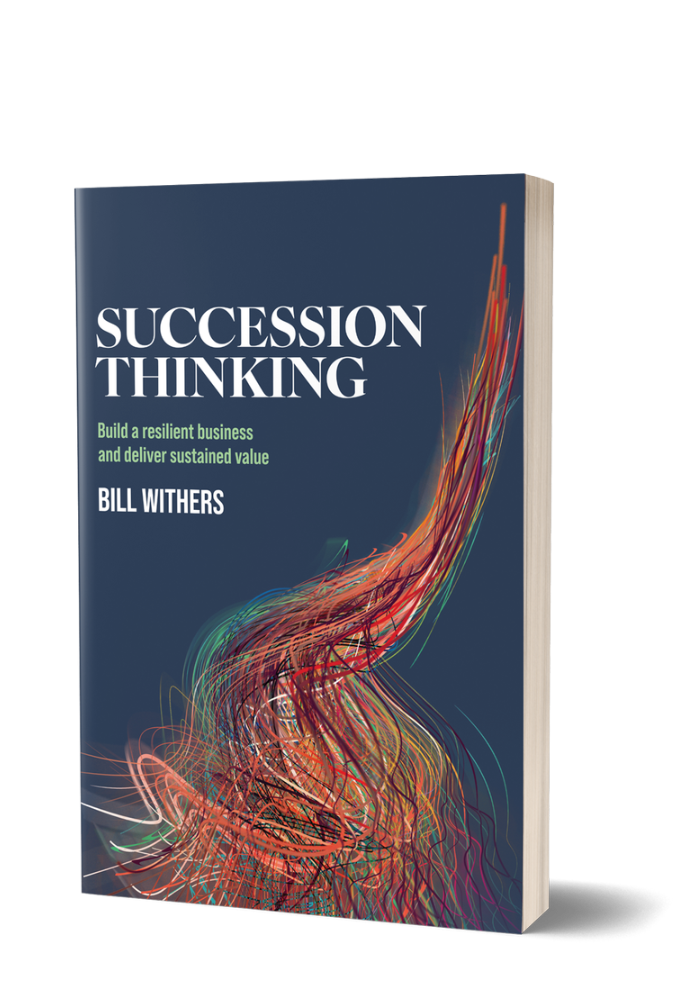
Everything Bill has learned across 36 years, codified into five principles any SME owner can act on. This is the foundation beneath the framework.
Get the BookAlso available as an audiobook
What founders say
Way beyond anything I've read or seen. A whole philosophy for SMEs towards succession planning and building a resilient business, with resilient teams clear on their purpose.
I have never seen another business operating system focused on founders and owners being on the business, not in the business.
We tried to build a healthy organisation for 10 years but struggled to put in place the culture, systems, and structure. The Adapt framework addressed the problem, delivering significant benefits for our business and 200 team members after only 12 months.
Framework Questions
What founders ask about the framework
Succession Thinking® is a structured framework developed by Bill Withers for SME owners who want to build businesses that run independently of their founders. It covers five principles: role clarity, the owners' vision (ROV), leadership beyond the founder, culture beyond the founder, and the Business Way. Together, these create the conditions for a business that performs consistently regardless of the founder's daily involvement. It is delivered through one-on-one advisory, keynote speaking, and the Design For Succession retreat.
ROV, Return on Vision, is a different measure of business success from the traditional ROI lens. When ROI drives every decision, owners build to exit. ROV puts the founder's vision at the centre and investment at its service. Decision rights, capital allocation, and leadership structure flow from what you are actually building toward, not a quarterly target or a transaction. It is the conceptual foundation beneath the entire Succession Thinking® framework.
The Business Way is the operational and cultural system that allows a business to function consistently without its founder present. It goes beyond a process manual, capturing how decisions get made, how the team communicates, and the operating logic that makes the business distinctly itself. Without it, every leadership change, new hire, or extended founder absence creates unnecessary chaos. Within the Succession Thinking® framework, the Business Way is what makes independence durable rather than accidental.
An Owner-Leader is a founder who still carries operational accountability: running the organisation leadership team, leading teams, or performing technical work alongside owning and directing the business. An Owner-Director has completed the handover of those operational roles and now works at the governance level: setting vision, stewarding culture, allocating capital, and fulfilling director responsibilities. The Owner-Director governs the business. The Owner-Leader still runs it. The Succession Thinking® framework is built to make the Owner-Director transition achievable. Read the full article on this transition.
Most business coaching focuses on improving the founder's performance: better decisions, sharper strategy, clearer habits. Succession Thinking® inverts that goal entirely. The aim is to build a business that performs independently of how well the founder performs on any given day. It is a structural framework, not personal development. Bill Withers works with founders who have already built something real and are ready to make it genuinely independent.
No, and that distinction matters. Succession Thinking® is a framework for building a business that runs independently of its founder. What you do with that independence is your choice: stay and grow, step back from day-to-day operations, or eventually sell. But a business that cannot function without you has no real succession options regardless of intent. The framework creates the independence first. The rest is up to you.
Two ways in
Experience the framework.
Or hear it first.
The retreat delivers the complete framework over two immersive days. Bill's keynotes bring the thesis to your room.